How to Make Money Trading Meme Coins
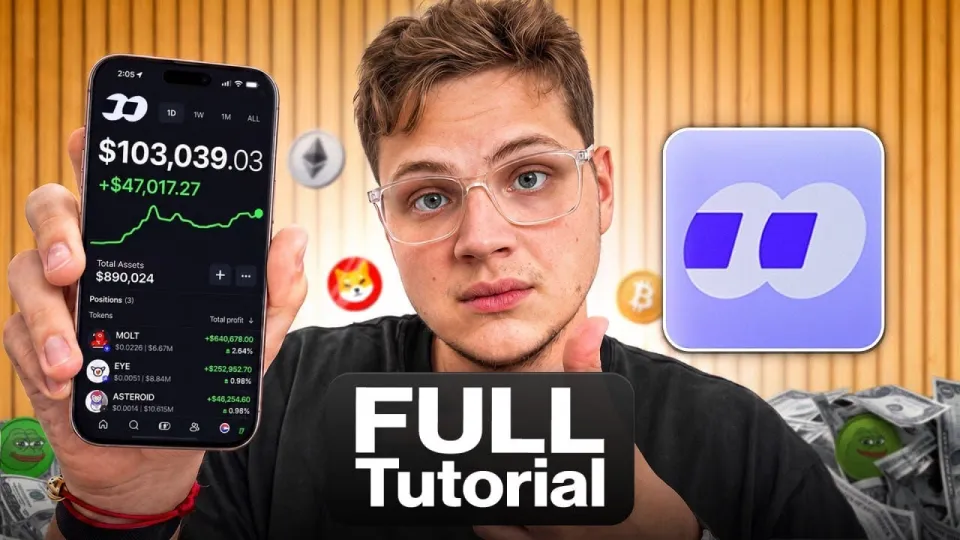
Video: How To Make Money Trading Memecoins (fomo app tutorial)
Need articles like this for your video? They help promote it on YouTube and Google — order them in the Telegram bot @sat_sit_bot. The bot writes and publishes the articles itself (with your YouTube video embedded) on popular topical websites (no ads). Free trial — 50 articles.
· based on the channel Orangie Web3
Meme coin trading is the practice of buying and selling tokens whose price is driven by attention, community and liquidity rather than by revenue or product fundamentals. The goal is to capture short bursts of demand and sell into them before the crowd exits. Platforms like the fomo trading app compress discovery, charting and execution into one interface, which is why they have become the default entry point for retail traders on Solana.
The workflow in the Orangie Web3 tutorial is deliberately simple: find a token, check its chart and liquidity, size a position, and set an exit before you enter. That simplicity is the point. Memecoins reward speed and discipline, and punish improvisation.
What a meme coin actually is and why it moves
A meme coin is a token with no cash flow, no claim on assets and no roadmap obligation; its price is a pure function of supply, liquidity and the number of buyers who want in right now. Dogecoin is the archetype, but the current generation launches on Solana in minutes through fair-launch tools, with liquidity pooled on decentralized exchanges.
This structure explains the price behaviour. When a token trends, new buyers arrive faster than sellers, and thin liquidity amplifies every purchase. When attention rotates away, the same thin liquidity amplifies the fall. There is no earnings report to anchor a valuation, so the only real inputs are:
- Liquidity depth — how much capital it takes to move the price 10% in either direction.
- Holder distribution — whether a handful of wallets control most of the supply.
- Volume trend — whether trading activity is expanding or fading.
- Narrative freshness — whether the joke or theme is new to the market or already exhausted.
A token with $30,000 of liquidity can double on a few thousand dollars of buying and lose half of that gain on a single sell. That asymmetry is the entire opportunity and the entire risk.
How the fomo app fits into a memecoin trade
The fomo app is a trading front end that lets you browse trending tokens, open a chart, and buy or sell from the same screen, with the referral link at https://fomo.family/r/orangie giving access to the platform. Instead of juggling a scanner, a charting tab and a wallet extension, the flow stays in one place.
A typical session looks like this:
- Open the trending or new-token feed and shortlist two or three names with rising volume.
- Check the chart for a real consolidation or pullback rather than a vertical candle you would be buying at the top.
- Confirm liquidity and holder concentration before committing capital.
- Enter a position size you can lose entirely without changing your plan.
- Set a take-profit target and a hard stop level, then execute the sell at those levels rather than on emotion.
The interface removes friction, but it does not remove the need for a thesis. A fast buy button is equally efficient at getting you into a bad entry.
Position sizing and risk rules that keep you solvent
Survival in memecoin trading is a risk-management problem before it is a picking problem. Because a token can go to zero, the correct mental model is that every position is a lottery ticket with a known maximum loss, not an investment with a recoverable drawdown.
Practical rules that traders converge on:
- Cap any single memecoin at 1–5% of your trading capital, so a total loss is annoying rather than fatal.
- Decide the exit before entry: a realistic target (often 2x–5x on a momentum trade) and a stop that you actually honour.
- Take partial profits on the way up; selling half at 2x turns a speculative bet into a free option on the rest.
- Never add to a losing memecoin position to average down; the thesis was attention, and fading attention is the signal.
- Keep a separate wallet for experiments so a drain does not touch your main holdings.
A viewer in the comments described losing a wallet, reloading with $90, making about $30 and then giving it back — a textbook outcome of trading without position caps. The amount is small, but the pattern scales to any balance.
Copy trading and the timing trap
Copy trading feels like the shortcut, and it is the most common source of avoidable losses in memecoins. Large traders frequently buy a token on a secondary wallet before buying on the wallet that followers can see, which means the public entry is already the pump they are trying to front-run.
By the time a copy-trade notification reaches you, three things have usually happened: the price has moved, liquidity has thinned as early buyers sit on the bid, and the trader's own exit plan is unknown to you. You inherit the risk without the information.
A more defensible use of wallet tracking is research rather than execution. Watch which wallets consistently buy early, note the tokens and the timing, and then build your own entry criteria. Treat visible wallets as a signal to investigate, never as an instruction to buy.
Common questions from new memecoin traders
New traders ask the same handful of questions, and the answers are mostly about expectations rather than tactics. Memecoins look less intimidating once the mechanics are explicit.
How much can I realistically make? Most trades should be assumed to be losses or small gains. The distribution is heavily skewed: a few outsized winners pay for many small losses, so a strategy that cuts winners early and holds losers will lose money even with a good hit rate.
Do I need a large bankroll? No, but you need enough to take meaningful partial profits and to survive a string of losses. Trading $90 with the aim of turning it into rent money is a recipe for oversized risk.
What is missing from the tools? The most requested feature under the tutorial was price alerts, and the reason is structural: memecoin moves resolve in minutes, so manual chart checking is too slow. Until alerts exist, set your own price levels and check on a schedule rather than compulsively.
Is this gambling? The mechanics are closer to speculation on attention flows than to investing, and honest traders treat it that way — fixed maximum loss per bet, no borrowed money, no averaging down.
Useful links
Final takeaways on meme coin trading
Meme coin trading can make money, but the edge comes from process rather than prediction: small fixed positions, exits defined before entry, partial profit-taking, and a refusal to chase visible wallets. The fomo app shortens the distance between an idea and a fill, which makes discipline more important, not less. Start with the fomo platform registration, trade amounts you can lose without changing your life, and review every trade against your own rules. The walkthrough above comes from Orangie Web3, whose channel covers the practical mechanics of on-chain trading for newcomers.
Key takeaways
- Meme coins are sentiment-driven tokens, usually launched on Solana, where price is set by attention and liquidity rather than revenue or fundamentals.
- The fomo app (fomo.family) bundles token discovery, charts and buying into one interface, so a trade can go from feed to fill in seconds.
- Copy trading lags: large traders often buy on a separate wallet first, so followers enter at a worse price than they expect.
- Most memecoin losses come from oversized positions and no exit plan, not from picking the wrong ticker.
- Price alerts are the most requested fomo feature among viewers, because memecoin moves happen faster than manual chart checks.
Source: How To Make Money Trading Memecoins (fomo app tutorial) · Markdown version
Questions & answers
How do beginners make money with meme coins?
By treating each trade as a capped-risk bet: small position sizes, an exit target and a stop decided before buying, and partial profit-taking as the price rises. The edge comes from consistent process across many trades, not from finding one perfect token.
Is copy trading memecoins profitable?
Rarely for the follower. Large traders often buy on a separate wallet before the wallet you can see, so by the time a notification arrives the price has already moved and you enter at a worse level with no knowledge of their exit plan.
What should I check before buying a new memecoin?
Liquidity depth, holder concentration and whether volume is expanding or fading. Thin liquidity with a few dominant wallets means the price can collapse on a single sell, regardless of how strong the narrative looks.
Does the fomo app have price alerts?
Price alerts were the most requested feature among viewers of the tutorial, since memecoin moves resolve faster than manual chart checks. Until they are available, set your own levels and check on a fixed schedule instead of watching charts constantly.